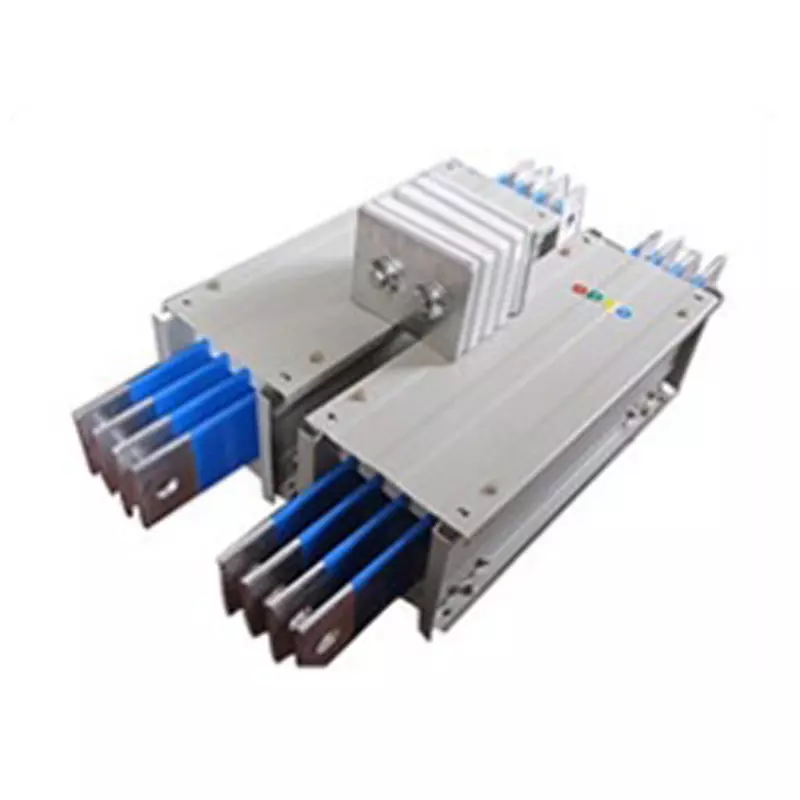
Air-Insulated Busway (AIB) – Product Overview
Product Definition & Core Technology
The Air-Insulated Busway is a power distribution system that utilizes air as the primary insulating medium between conductive busbars, enclosed within a metallic housing. Designed for efficient and flexible power transmission in commercial, industrial, and infrastructure applications, it offers a reliable alternative to traditional cable-and-conduit systems.
Key Features & Advantages
-
High Conductivity & Heat Dissipation
Copper or aluminum busbars with optimized cross-sectional design ensure efficient current carrying and natural heat dissipation through air circulation.
-
Modular & Flexible Installation
Prefabricated sections with standardized lengths and flanges enable rapid, customizable routing and easy system expansion.
-
Low Impedance & Voltage Drop
Optimized phase-to-phase spacing and conductor arrangement minimize power losses over long distances.
-
Enhanced Safety
Fully enclosed, grounded metallic enclosure provides mechanical protection and prevents accidental contact.
-
Cost-Effective Maintenance
Visible connections and accessible joints simplify inspection and reduce downtime.
Typical Specifications
-
Current Ratings: 400A – 6300A
-
Voltage Ratings: Up to 1000V AC
-
Insulation Class: Class B (130°C) or higher
-
Protection Rating: IP54 to IP66 (dust/water resistant)
-
Compliance Standards: IEC 61439-6, GB 7251.6, UL 857
Common Configurations
-
Feeder Busway: For main power distribution from source to substations.
-
Plug-in Busway: With evenly spaced tap-off points for flexible branch connections.
-
Rising Main Busway: Designed for vertical power distribution in high-rise buildings.
Industry Applications
-
Manufacturing plants & industrial facilities
-
Data centers & telecom infrastructure
-
Commercial complexes & high-rise buildings
-
Renewable energy plants (solar/wind farms)
-
Transportation hubs (airports, metro stations)
Comparison with Alternative Types
Selection Guidelines
-
Environment: Suitable for dry, indoor, or well-protected outdoor installations.
-
Load Profile: Ideal for stable, high-current applications with moderate frequency of changes.
-
Space Constraints: Requires adequate ventilation space around housing for optimal cooling.
-
Future Flexibility: Easily reconfigured or extended with additional sections and tap-off boxes.