RS Series Racks
Our company's racks include TQJ series steel structures, LQJ series aluminum alloy structures, FQJ fireproof materials, and BQJ fiberglass series of various specifications for cable racks. The main types are divided into step-type, trough-type, tray-type, and combined-type. We can also produce large-span and large-sized racks according to user requirements. At the same time, the production of BQJ series fiberglass racks, FQJ series fireproof racks, and flame-retardant racks (various specifications) has well addressed the application requirements for fire prevention, anti-corrosion, and flame retardancy in specific places.
The steel cable trays produced by our company are made from high-quality plates produced by large domestic steel mills. We can also produce them according to the requirements of users. The thickness of the plates is in accordance with industry and customer standards. The cable trays are manufactured using advanced equipment and advanced welding techniques, featuring good overall strength, no deformation, no false welding, smooth and attractive appearance, etc. The surface treatment of steel cable trays generally includes powder coating, hot-dip galvanizing, zinc-nickel alloy plating, and passivation. Users can choose the treatment method according to their own design needs.
1. Galvanizing and fire-resistant paint spraying production process: After the steel cable frame is subjected to acid washing, degreasing, and oil and rust removal, it is rinsed with clean water, acid-removed, and then phosphated. The phosphating thickness should be no less than 6 μm. The products after phosphating have a strong adsorption capacity for galvanized products. The quality of phosphating will directly affect the galvanizing quality. After drying, the galvanized products are sprayed with fire-resistant paint, and the average layer thickness should be ≥ 50 μm, with adhesion strength not lower than Grade III. At the same time, it can also be customized according to user requirements, and there are many colors to choose from, specified by the user.
2. Hot-dip (immersion) zinc production process: After the steel cable frame is degreased, acid-washed, oil and rust removed, it is rinsed with clean water and then placed in a solvent pool. After drying, it is immersed in a zinc pool (500°C - 600°C), usually for 10 minutes. After cooling, the traces and burrs are removed, and then tested that the zinc layer thickness is ≥ 55 μm.
3. Galvanizing nickel alloy production process: After the steel cable frame is degreased, acid-washed, oil and rust removed, it is rinsed with clean water, acid-removed, and then enters the zinc-nickel alloy electroplating. The coating thickness should be ≥ 12 μm.
4. Passivation production process: After the steel cable frame is degreased, acid-washed, oil and rust removed, it is rinsed with clean water and then galvanized in an electroplating tank. After galvanizing, it is placed in a chromium salt solution tank for passivation. The colors after passivation include military green, silver white, rainbow color, etc., which can be chosen by the user.
FQJ series fireproof cable trays and flame-retardant cable trays mainly consist of unsaturated polyester resin, glass fiber, flame retardant agent, flame retardant agent, etc., and are formed by compounding molding material. They have fire resistance, heat insulation, self-extinguishing, and corrosion resistance. In places with high fire requirements, fire-resistant materials can be added between the cable tray and the composite material to increase the fire resistance level. At the same time, they also have the advantages of light structure, good aging resistance, safety and reliability, and beautiful appearance. They can be conveniently used in conjunction with metal cable trays and are widely used in strong corrosive environments such as chemical, metallurgy, and petroleum.
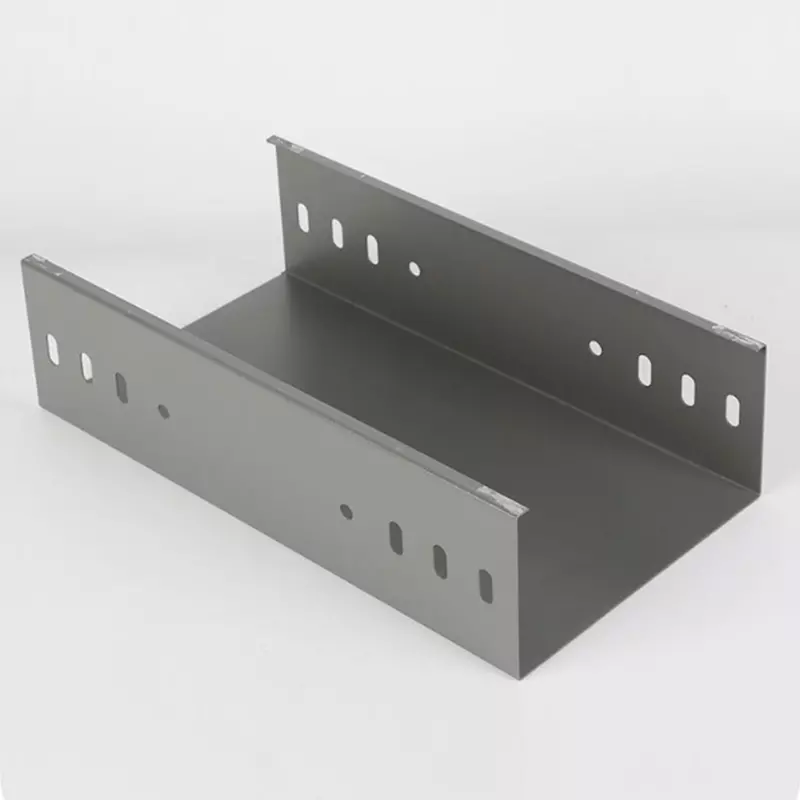
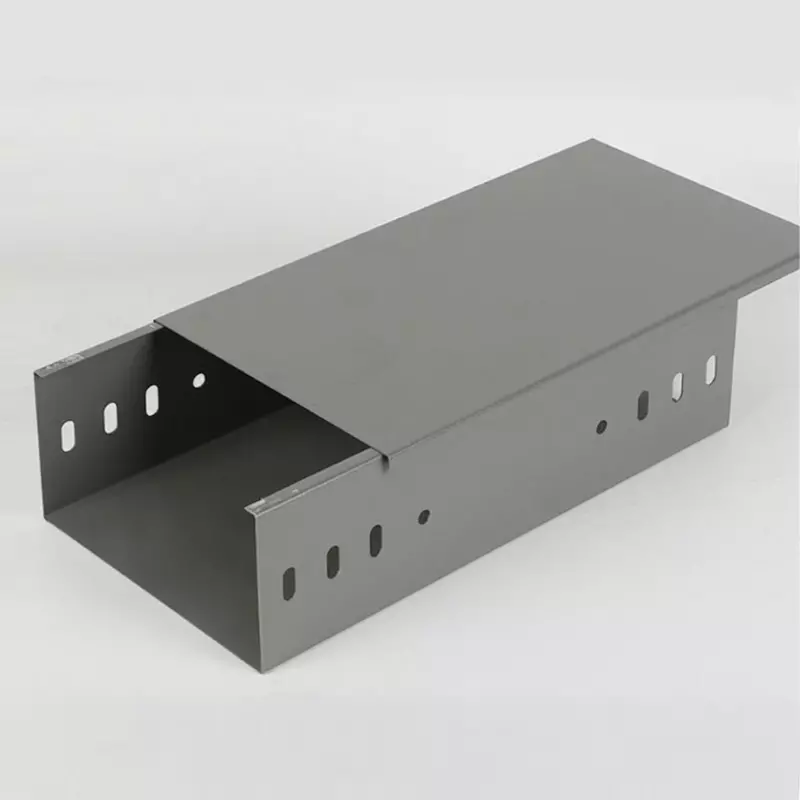
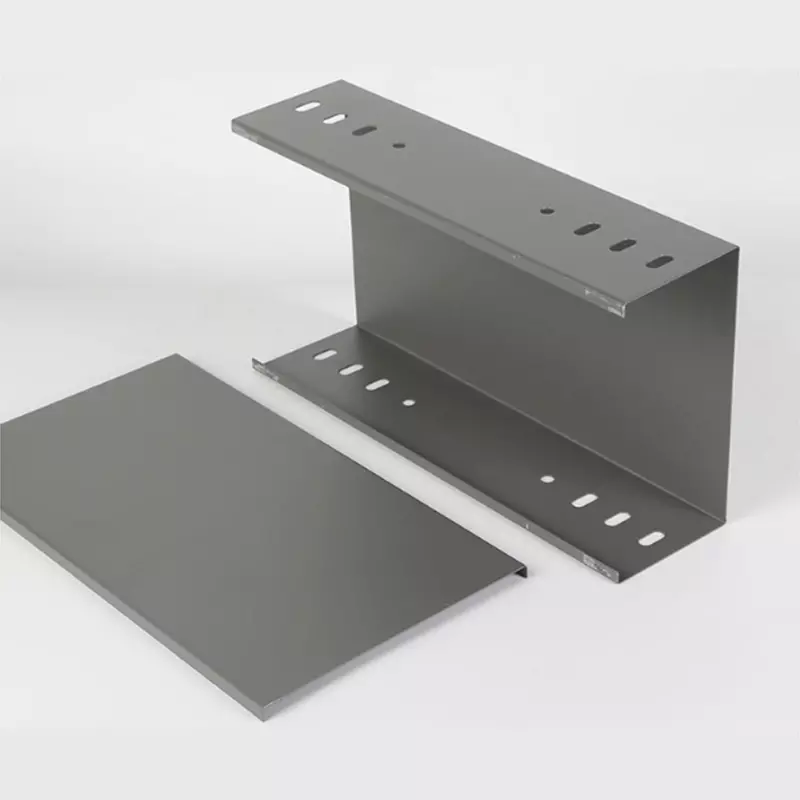
The universal trough-type cable tray is a fully enclosed type of cable tray. It is suitable for computer cables, communication cables, thermocouple cables, and other control cables for high-sensitivity systems. It has a good effect in shielding interference for control cables and protecting cables in environments with severe corrosion.
The tray-type cable tray is the most widely used type in industries such as petroleum, chemical engineering, power, lighting, television, and telecommunications. It has the advantages of light weight, good heat dissipation performance, beautiful appearance, simple structure, and convenient installation. It is suitable for both the installation of power cables and the laying of control cables.
The stepped cable tray was developed by our company based on imported Japanese technology and in combination with domestic characteristics. It features light weight, low cost, unique design, convenient installation, good heat dissipation and ventilation, etc. It is suitable for the laying of general large-diameter cables, and is particularly suitable for the laying of high and low power cables.
The modular cable tray is a new type of cable tray, being the second-generation product in the cable tray series. It is suitable for various projects, various units, and various types of cables. It has the advantages of simple structure, flexible configuration, convenient installation, and novel appearance.
The modular cable tray can be assembled into the size you need by using three base types with widths of 100, 150, and 200 mm. It does not require the production of fittings such as elbows and trisets, and can be turned, widened, branched, and led up or down as needed for on-site installation. At any position, it can be led out using pipes without the need for drilling or welding. It is not only convenient for engineering design but also for production and transportation, and is more convenient for installation and construction. It is currently the most ideal product among cable trays.
The large-span cable tray is a type of cable tray with a larger supporting span compared to the ordinary ones. Due to its reasonable structural design, it also has the characteristic of greater load-bearing capacity than the ordinary cable trays. Therefore, it is not only suitable for the indoor cable tray laying in industrial and mining enterprises such as oil refining, chemical industry, textile, machinery, metallurgy, power, television, and radio, but can also be used for the cable laying in underground facilities such as subways and civil defense projects.
The aluminum alloy cable tray is independently developed by our company based on the American NEMAB standard NOVE1-1979 "CABLE TRAY SYSTEMS". It features a simple structure, novel design, long service life, convenient installation and maintenance, and no need for upkeep. It can be applied to a wide range of environmental conditions. It can be used in coastal salt spray areas, high-temperature, high-humidity and corrosive environments, and can more prominently demonstrate its anti-corrosion performance.
The RS-FQJ series fireproof cable tray is a new type of product independently developed by our factory, which can meet the requirements of fire prevention and flame retardancy. Due to its advantages such as light structure, high load-bearing capacity, safety and reliability, and convenient installation, it can be widely applied in environments with fire protection requirements in industries like chemical, petroleum and metallurgy, bringing significant economic benefits to users.
The RS-BQJ1 type fiberglass reinforced plastic cable tray is composed of glass fiber reinforced plastic, flame retardants and other materials. It is formed by compounding molding material and pressing with a stainless steel shielding mesh. Due to the selected materials having a low thermal conductivity and the addition of flame retardants, the product not only has fire resistance and heat insulation properties, but also has high corrosion resistance. It also has the advantages of being lightweight, resistant to aging, safe and reliable. It can be conveniently used in conjunction with metal cable trays and is applied in strong corrosive environments such as in chemical, metallurgical and petroleum industries.
The RS-BQJ2 type fiberglass cable tray is made of reinforced fiberglass material. Reinforced fiberglass is obtained by immersing continuous glass fibers, non-twisted coarse sand glass fibers, surface felts, etc. as reinforcing materials in heat-curable resin, and then pulling it out from a heated metal mold under the action of traction force. The resin is cured under high temperature and high pressure, thus obtaining a continuous, smooth surface, stable size, and extremely high strength type of fiberglass profile. The reinforced fiberglass material has a dense reinforcing fiber and is formed under high temperature and high pressure. Therefore, the material composition of the RS-BQJ2 type fiberglass cable tray is more reasonable, has stronger aging resistance, more uniform material, higher strength, more stable size, and a more beautiful appearance.